 |
|
| Review by: Rebecca Basham |
6/01/01 |
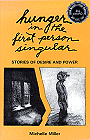 Michelle Miller’s Hunger in the First Person Singular: Stories of Desire and Power is the winner of the New Mexico Press Women’s "Best Book, 1993" under the auspices of the Zia award. It is actually an eclectic collection of one novella ("Hunger in the first person singular") and seven "stories of desire and power," that are interspersed with prints created by artist, Jude Catallo. Miller’s novella focuses on a nameless female character who has abandoned civilization and the role play that society perpetuates. The character, a successful writer "back there," has taken up residence in an abandoned ghost town first discovered by her father years ago before his death and archived on a map that she stealthily nabs from his study on the day of his death. The reader joins the story in the fourth year of the woman’s hermitage. Not having written during her first four years of living alone, the woman has just begun to feel the pull of language and the desire to put words down onto paper again. The first few chapters deal with her reasons for leaving the world at large and a discussion of her "hunger." Hunger, for Miller’s character, is descriptive of the literal--of sex, and of life, itself. In the character’s context, the word "hunger" can be applied to any bodily or mental function that might leave one feeling "empty" or unfulfilled. Having fallen prey to this hunger "back there," the woman has been quite content to divest herself of mirrors, fashion, hygiene and any other of the gender stereotypes that run most women’s (and men’s) lives in the "civilized" world. As the reader meets her, she is beginning to reconnect with language through a journal written on a roll of butcher paper left behind in her ghost town. She explains that she is choosing to write in the first person singular because she was advised so often by writing mentors not to do so. This is definitely a character who is interested, if not compelled, to break all of the rules. In the midst of her privacy and contemplation, the woman begins to "imagine" a male visitor. She imagines sexual intercourse a la’ Jong without language, without the role play and without the stereotypes that keep us from ever truly knowing each other. She imagines a man that can help her to sate her hunger. A short time later, the woman catches a glimpse of this "man" that she has seemingly conjured, bathing in the river, pouring tea in an abandoned cabin, meditating in her private room at the abandoned hotel. There is, of course, no language in their courtship, only brief glimpses of flesh and non-verbal introductions that are intriguing and provocative. The question is: is this man a real person; is he a creation of the woman’s hunger; is he her animus? The reader, and indeed the woman herself, is left wondering: "Oh, of course, there are impulses, throughout the day, to sit down and filter it through, to write an orderly chronology of events and try, from that, to determine the nature of the experience, to extract some rational understanding of it... As if ‘coming to a conclusion’ helped. As if it taught me anything at all... I am fighting those impulses to interpret, explain, conclude this sequence of events, or whatever they are" (94-95). Likewise, the conclusion that there is no conclusion is perpetuated in Miller’s seven stories of "desire and power," which concentrate on the alienation of the individual from society. From lost women who comb city dumps to find cast off treasures to recently divorced women turning down relationships with their comfortable, but unsparkable boyfriends, Miller focuses on women who have made the choice to live on their own terms rather than civilizations’. Whether her characters leave the world for an abandoned ghost town or just leave Chicago for New Mexico, they are leaving behind that which is sick within the female soul and are searching, always searching for the fulfillment of their individual and collective hunger. Read an interview with Miller on Amazon.Com... |
|