|
|
| Review by: Rachel Levin |
6/01/01 |
|
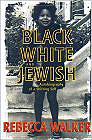
Rebecca Walker’s new autobiography, Black,
White, and Jewish: Autobiography of a Shifting Self is
a keen The unity of this originary point is in sharp contrast to the fragmentation she encounters once her parents leave the South for New York and soon after get divorced, and once she is thrust into new contexts of school, summer camp, and the streets of the city where people have mixed reactions to her hybrid appearance. The gulf between the two halves of her identity widens when her mother moves to San Francisco, where she is a working-class artist, and her father re-marries a Jewish woman and relocates to an all-white, upper-middle class suburb on Long Island. Her parents decide that she will alternate between these two worlds regularly, living with one parent for a span of two years, then with the other for the same time period. Thus, the oppositions between black and white, secular and Jewish, working-class and upper-class become increasingly pronounced in these bi-yearly shifts from west coast to east, from mother to father, from city to suburb. While many authors who write about identity have compellingly captured this experience of dual consciousness, what Walker does brilliantly is metaphorically capture the experience of the liminal spaces she occupies. She is a dancer who has to interpret different styles of sound and rhythm: "Moving from household to household is like switching between radio stations: Each type of music calls for a different dance, but it all exists simultaneously, on the same dial. Doing the switching is easy, it’s figuring out how one relates to the other that is hard" (39). She is a translator negotiating between different linguistic systems: "I feel as if we speak two different languages and I am the only one who can speak both, who even knows that there is more than one to be learned" (209). She is poised at the edge of a kind of spatial, geographical gap; "a border crosser, a human bridge" (242). She feels like she is "always standing outside the gate, wanting to be let in" (186). Yet, as this last metaphor of the guarded gate illustrates, Walker tends to frame her hybridity as a liability rather than as a privilege: she emphasizes how it always causes her to feel like an outsider rather than how it gives her access to an enormous variety of experiences, cultures, and places. Not to diminish the obvious struggles she has endured and will continue to endure from cultures that do not fully accept and understand her, I was struck with the range of worlds she was able to move in and out of in her young life. Of course, this movement was not effortless, but it afforded her what seems to be an incredible amount of rich insight into the world and into different cultures. This framing may be a function of the way she implicitly theorizes memory throughout the book. She begins the book by simply stating, "I don’t remember things," meaning small details like street names and the names of distant cousins. A good friend has theorized that memory is tied to the Mind, but Walker is certain that memory comes from the heart: "When it is time to remember her after she leaves it will be my heart—lazy, slow, decidedly not smart—that will pull and yearn and twist around like a dog in dirt…My heart will have registered the deeper meaning snaking and elusive beneath her disparate pieces; my heart alone will allow me to remember her whole" (2-3). And this book is absolutely about emotional memory—about recounting those memories that contributed to shaping her intellectual, cultural, sexual, racial, and gender identity. Yet, there are points in the book where the unfolding events of her life do not seem to be examined rigorously because she has relied, as she says, on her heart to remember for her. For example, after getting pregnant and having an abortion at age 14, she tells her mom that she needs to go to private school. "I don’t know where this comes from, really, this sudden exclamation," she says, ostensibly unable to remember, "…because it’s not like I’ve been thinking about it and it’s not like I know anybody my age who is actually in a private school. But I have just had an abortion at the age of fourteen, and we don’t read books in my English class, only mimeographed handouts, and Michael’s friends in college work for minimum wage parking cars" (250). Arguably, her ability to envision possibilities beyond what her public school friends in San Francisco had is a result of her hybridity, of the opportunities she had had to peer into other worlds. Perhaps the most disappointing part of the book is that Walker does not fully explore her own hybrid sexuality. While she gives detailed descriptions of her various sexual relationships with men, at the end of the book she implies that her current partner is a black woman, and that she has adopted this woman’s biological child as her own. Yet, unlike the accounts of her relationships with men, no narrative is given about who this woman is, how she met her, and what she has made her feel. I am unsure of why this realm was left unexplored. Why, for example, was the book not called Black, White, Jewish, and Queer? Perhaps Walker just wanted to focus on race and the black/white divide that has shaped her life. But then why include, in such great detail, her heterosexual experiences? By excluding homosexuality and instead giving so much space to heterosexuality, she both reinforces heterosexuality as an "unmarked" category of identity, and seems to seems to reinforce a notion that race, gender, and sexuality are separable components of identity. This goes against much black feminist thought, which, according to Valerie Smith, has always asserted that "ideologies of race, gender (and more recently class and sexuality) are reciprocally constitutive categories of experience and analysis" (xiii). Walker’s analysis of the forces that shaped her identity would have been richer had she not so marginalized her own bi-sexuality. Despite these places where Walker’s examination of the components of her identity seemed to fall short, Black, White, and Jewish is a powerful book. The prose is, in many places, poetry. Each metaphor for her hybridity is illustrated through choice and compelling examples from her young life. This is creative non-fiction at its best. What else could we expect from Alice Walker’s daughter, and from someone named by Time magazine as one of the fifty future leaders under age forty?
Works Cited Smith, Valerie. Not Just Race, Not Just Gender: Black Feminist Readings. New York: Routledge, 1998. Walker, Rebecca. Black, White, and Jewish: Autobiography of a Shifting Self. New York: Riverhead Books, 2001. |
|