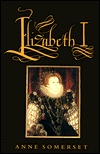
 Anne Somerset, Elizabeth I, St. Martin's Griffin: New York, 1991. 636pp. Anne Somerset, Elizabeth I, St. Martin's Griffin: New York, 1991. 636pp.
ISBN: 0312081839
Anne Somerset's biography of Queen Elizabeth
the First of England is a lengthy account of the life and times
of Elizabeth I, written in very lively prose, and it amounts
to a satisfying investigation
into this most fascinating figure. Somerset is a British historian
who has also written on William the Fourth and courtly ladies-in-waiting.
Certainly, her notes and extensive bibliography reveal her scholarship
to be quite thorough.
The book manages to balance the political and the personal so
that one reads a multi-dimensional portrait of Elizabeth. Biographies
of Elizabeth are not in short supply and many of them contradict
each other, especially when it comes to the question of Elizabeth's
efficacy as a ruler and her personality. Somerset, interestingly,
treats Elizabeth's personal foibles with delicacy, but at the
same time makes her come across as oddly passive in the realm
of political decision making. Elizabeth seems overly cautious,
so preoccupied with thoughts of usurpation and so unwilling to
commit to warfare that she seems to loll about in indecision
until action is totally unavoidable. Somerset seldom attributes
this any positive qualities, only once does she suggest that
this is Elizabeth's calculated modus operandi. I, and other biographers,
find this hard to swallow: Elizabeth was incredibly well-educated
and held her own, as a single woman, during a very long and tempestuous
reign. She founded the Anglican church, subdued Spain, warded
off France, and made incredible forays into the "New World."
As such, the idea that she was so easily distracted by romance,
indecision, or paranoia, does strain credulity.
It is surprising that Somerset, as a woman, allows such puzzling
contradictions to go unexamined. Granted, not every female author
must examine feminist questions, but considering the recent date
of its publication, I anticipated a more thoughtful critique
of gender issues in the period. Also, one wonders where Elizabeth's
voice is in all of this. Elizabeth the First wrote prolifically
her entire life, and her speeches are well recorded, but Somerset
seldom quotes her directly, preferring to interpret events and
attitudes rather than present primary sources and let the reader
sort out things for herself. Elizabeth's creation of the idea
of the Virgin Queen, and its propagation through art and literature,
is also given short shrift, which is odd given the pressures
brought to bear on Elizabeth to marry and conceive an heir. Her
questionable liaisons with men are given a large amount of attention
and often cast her in an unflattering light. This is further
compounded by the impression that her statesmanship was not all
that it could have been.
Nonetheless, descriptions of Elizabeth's entanglements with Spain,
Rome, France, and, of course, Mary Queen of Scots, make for excellent
reading. Furthermore, anecdotes about Elizabeth's proclivities
for sweets, hunting, bearbaiting and dancing-- as well as her
deep and fruitful relationship with several of her councilors
and courtiers-- round out tales of the strictly "historical"
business of ruling. Somerset has a very engaging style for a
historian and I found the book engrossing despite its deficiencies.
Obviously, to get a full sense of an era or a person, one must
look into many sources, always taking into account the prejudices
and silences of the author. I plan to read another biography
and see what kind of a portrait it paints, especially in terms
of Elizabeth's own apologies for her political strategy and its
treatment of her status as unmarried female monarch. This account
is an excellent place to begin one's study of Elizabeth I and
Somerset has adequately piqued my interest in, and respect for,
this remarkable and successful female monarch. |
