 |
|
|
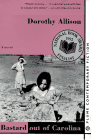 What makes a person white trash and what does it mean to be inscribed in this powerless class? Is the trashiness biological, a product of tainted blood, or is it strictly economic? What role does behavior play in this outcast whiteness? From the perspective of the southern poor white, what do other races and socioeconomic classes look like? Moreover, how can a young woman transcend this position of utter powerlessness? These are a few of the theoretical questions raised by Dorothy Allison in her book based on her childhood in Greenville, South Carolina. Not only were the Boatwrights poor but they drank, they were violent, and while all of the men were dangerously virile some were also sexually abusive. This behavior and their poverty earned the family the status of "poor white trash." Moreover, though the Boatwrights looked white, their blood was rumored to be colored by several races of Americans. Allison's autobiographical exposition is one which challenges race, economics, and class simultaneously. In the book, images of blackness are more beautiful than the dirty whiteness of the poor white family. And images of pure whiteness are utterly repellant. The hierarchy of racial beauty (and power) is thus upset. Allison renders American Indians and African Americans more beautiful than the disempowered and hated white trash community. Moreover, Allison paints socially accepted white people in the most grotesque light of all. Though the Boatwrights are physically white, they are socially, biologically, and economically colored. That is, they do not have access to the power which is usually the privilege of whiteness in this country. (See Peggy MacIntosh's "White Privilege: Unpacking the Invisible Knapsack.") As such, the white trash community in the novel is a locus for what seems to be impotent, primal rage. It is the rage of the Boatwright mens' dispossessed whiteness. It is the rage of Annie Boatwright when her daughter is called "bastard." And it is also the rage of a little girl called Bone who finds herself the weakest member of an economically powerless and socially marginal family. The book, at its heart, is about this apparently powerless rage of an abused little girl who comes abruptly to womanhood in traumatic violence. Dorothy Allison explains her own anger by saying in an interview with Carolyn Megan that she "couldn't write this story from rage; it had to be from a place of compassion. I had to get to a place of understanding these people." While Allison had to wait many years to learn to think through her rage, she talks of Bone's rage as if it saved her from an inability to feel and a failure to act upon her own life. When asked by Megan if anger saved her (and Bone) Allison says, "Not only anger, but to realize the justification of it. The thing that happens with you if you're poor, or you're powerless, or you're in the situation that Bone is in, suffering any kind of physical or emotional abuse, is that you begin to feel kind of numbed. . . ." This numbness prohibits not only feeling but action and thought as well. Rage then becomes an agent for positive change. In her rage Bone identifies with the powerful black Indian warrior, and so her mixed blood enables her empowerment just as her whiteness has left her weak and powerless. This is a reversal of the general roles power plays in the color schematic of the South and in America in general. Bone's rage comes out of her economic and racial dispossession and is in fact a powerful force in her life-- it is the only force which gives an identity she can accept with pride. Patricia Williams in Alchemy of Race and Rights has described this justifiable and necessary anger as "intelligent rage."Unlike most evocations of physically torrential, intellectually unharnessed emotion, this type of anger is reminiscent of feminist rage at women's oppression and can be a useful, calculated, and precisely powerful emotion used to do positive social work. This rage, as it is written by Dorothy Allison, is not a disempowered emotion which takes over her body and numbs her brain. It is not a symptom of Bone's or Allison's loss of control but it instead represents the very agency by which Bone gains control of her self and of her identity. Bone's "intelligent rage" is not a symptom of her trashy violence. Rather, it begins to work against the racism, classism, and sexism represented by Allison's poor raging girl. Bastard Out of Carolina thus becomes a metaphor for the potential of emotional and intellectual power imbedded in America's second-class citizens. MacIntosh, Peggy. "White Privilege: Unpacking the Invisible Knapsack." Independent School (Winter 1990) 31-35. Megan, Carolyn E. "Moving Toward Truth: An Interview with Dorothy Allison." Kenyon Review (Fall 1994) Vol. 16 Issue 4, 71-84. EBSCO Publishing, item 9411091211. Williams, Patricia J. The Alchemy of Race and Rights. Harvard: Harvard UP, 1991. |
|
|
|
|