 July 1, 1876-July 27, 1948 [ Links ] [ Criticism ] [ Bibliography ] Domestic Goddesses Home ]
After graduating from college, she joined the Des Moines
Daily News; during this time she wrote the short stories
that appeared later in Daily Masks (1912). What is unusual
about these short stories is that she describes women who are
strong and men who are sensitive and intuitive, and by the standards
of their time, weak. Many of the stories ask similar Just after her marriage, Glaspell wrote her most famous novel,
Fidelity,
which has a plot similar in some ways to her romance and ensuing
marriage. The protagonist of Fidelity, Ruth Holland, has
been compared to Kate Chopin's Edna Pontillier in The Awakening,
and indeed, there is much in common between the two characters.
Like Chopin's novel, Fidelity was condemned by reviewers
as "a very unwholesome story" because of its frank
portrayal of an adulterous affair. Fidelity is as important
as any novel by Chopin, Gilman, Wharton or Cather; the reason
it has been neglected is twofold. Its author may have rejected
the conventions of nineteen-century melodrama, and therefore
missed that category, but she rejected as well the Nowadays, Glaspell is mostly thought of as a playwright-- which indeed she was, even though she primarily thought of herself as a novelist. Many of Glaspell's feelings about Iowa were written into her plays, and into two in particular-- Trifles and Alison's House, which won the Pulitzer Prize in 1931. Trifles, and the 1917 short story based upon in, "A Jury of Her Peers," has become a classic feminist text and is performed and taught in colleges and universities all over the world. In 1919 Glaspell wrote The Verge, a still-shocking experimental play. Glaspell died of pulmonary embolism and viral pneumonia on 27 July 1948. Researchers, see especially the Glaspell entries in The Dictionary of Literary Biography: DLB 7: Twentieth-Century American Dramatists The majority of Susan Glaspell's papers are housed in the Henry W. Berg and Albert A. Berg Collection of English and American Literature in the New York Public Library. Also of interest are the Provincetown Players Theater Collection, office files, and clippings scrapbook housed in the Billy Rose Theatre Collection of the Library and Museum of the Performing Arts at Lincoln Center the Provincetown Players File at the Museum of the City of New York the Susan Glaspell Papers in the Clifton Waller Barrett Library at the University of Virginia and the Susan Glaspell Collection of the St. Ambrose College Library in Davenport, Iowa. Biographical text on this page was graciously contributed by Laura Godwin, from an essay reprinted here by permission. Interested parties can read Godwin's complete analysis of Glaspell's career in the introduction to Fidelity. To order your copy of Fidelity, click here. Photos of Glaspell and Gig copyright the Library of Congress. |
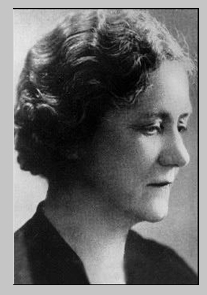 Susan
Glaspell was born, it seems, in 1876 (for she would later lop
six years off her age) a 'real old Yankee' whose pioneer ancestors
had settled in Davenport, Iowa, on the site of the former Native
American village of Oshkosh. In 1926, Glaspell described her
family as "middle class, not very well-to-do." The
atmosphere of hard work and endeavor in which she was brought
up would be an important influence on her career as a writers.
Like the heroine in her novel Fidelity, Glaspell "wanted
to go to college but her father had kept her from it." Unusually,
she was allowed instead to work on the local paper and then spent
a year as Society Editor on the Weekly Outlook. A year
later, she took the unusual and brave decision to enroll herself
at Drake University in Des Moines. It meant that people began
to wonder if she was not perhaps a little odd, and there were
rumors of her health being affected.
Susan
Glaspell was born, it seems, in 1876 (for she would later lop
six years off her age) a 'real old Yankee' whose pioneer ancestors
had settled in Davenport, Iowa, on the site of the former Native
American village of Oshkosh. In 1926, Glaspell described her
family as "middle class, not very well-to-do." The
atmosphere of hard work and endeavor in which she was brought
up would be an important influence on her career as a writers.
Like the heroine in her novel Fidelity, Glaspell "wanted
to go to college but her father had kept her from it." Unusually,
she was allowed instead to work on the local paper and then spent
a year as Society Editor on the Weekly Outlook. A year
later, she took the unusual and brave decision to enroll herself
at Drake University in Des Moines. It meant that people began
to wonder if she was not perhaps a little odd, and there were
rumors of her health being affected.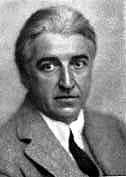 questions
to do with male-female stereotypes, the possibility of romantic
love within marriage, the constraints of society upon free will:
in particular, their author is acutely conscious of the difficulty
of reconciling passion (the irrational, the primeval) with bourgeois
marriage (the cash nexus, social restraint). During her twenties,
she became a well-known writer of short stories and a member
of several elite "societies" in Davenport, where she
lived. She fell in love with a married man, Jig Cook (photo to
right), and in order to try to stay away from him, spent 1909
in Paris. Their attempts to stay apart inevitably failed and,
in 1911, Jig left his wife and married Susan shortly after.
questions
to do with male-female stereotypes, the possibility of romantic
love within marriage, the constraints of society upon free will:
in particular, their author is acutely conscious of the difficulty
of reconciling passion (the irrational, the primeval) with bourgeois
marriage (the cash nexus, social restraint). During her twenties,
she became a well-known writer of short stories and a member
of several elite "societies" in Davenport, where she
lived. She fell in love with a married man, Jig Cook (photo to
right), and in order to try to stay away from him, spent 1909
in Paris. Their attempts to stay apart inevitably failed and,
in 1911, Jig left his wife and married Susan shortly after. conventions
of the modernist novel. Fidelity was recently re-released
by
conventions
of the modernist novel. Fidelity was recently re-released
by