
|
|
|
| Review by Debby Thompson |
March 14, 2000 |
|
Our Bodies Are Ourselves: Review of
Joan Jacobs Brumberg, The
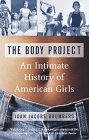
Body Project: An Intimate History "[B]ad things are happening to women's vagina's everywhere" This statement, from the text of Eve Ensler's performance piece The Vagina Monologues (xxii), serves as its writer's motivation and bottom line. It could well do the same for Joan Jacobs Brumberg's The Body Project. Both works aim, first and foremost, to address the bad things happening to women's bodies, and the rampant female self-hatred in our culture. As such, they choose to make their works accessible to a mainstream, non-academic audience. In the process, they lose some of the theoretical sophistication that Brumberg has shown in earlier works (particularly Fasting Girls: The Emergence of Anorexia Nervosa as a Modern Disease, 1988), and dodge, at their peril, important theoretical debates about the "natural," "biological" body as a stable referent, or the "repressive hpothesis" of the Victorian era that Foucault so roundly countered and complicated in his Introdution to The History of Sexuality. Both works leave unexplored some important questions about autonomy and agency, and about the power of silence to produce as well as withhold discourse (and vice verse). But perhaps feminist work has been so preoccupied with complicating the status of "the body," and so careful to avoid naive discourses of biological determinism and essentialism (which can be detrimental to feminism), that we have been unable to advocate for female bodies with the positive boldness that these works assert. The Body Project, a historical survey of certain sites of cultural focus on the bodies of teenage girls (sites such as skin, hair, and menstrual fluid), is the more academic of the two books. In addition to scholars, though, it should also reach the same readership as that of Naomi Wolf's The Beauty Myth and Promiscuities, or Mary Pipher's Reviving Ophelia. The main thesis of The Body Project is that our current culture is more body-centered than American cultures of the past, that young girls today define their "selves" in terms of their bodies, that "girls today make the body into an all-consuming project in ways young women of the past did not" (xvii), and that the bodies (and body-angst) of adolescent girls are primary markers of their culture. Whereas in the past, female bodies may have been (too) remote from female selves, today our bodies are ourselves. When American girls of the Victorian era referred in their diaries to "self-improvement," they meant improvement of character; today they are more likely to mean improvement of their bodies -- particularly their weight, shape, skin, and hair. Brumberg takes seriously the body-directed angst of teenage girls, and historicizes such concerns as acne and "feminine hygiene" and such practices as shaving and depilation, dieting, and body-piercing. Brumberg finds, for example, that unlike a century ago, when menarche and menstuation symbolized reproductive capacity and sexuality, which were then anxiously guarded, girls experiencing menarche today think more about the externals of menstruation (smells, seepage through clothes) than about "the emotional and social meaning of the maturation process" (29). Though girls today are better informed about menstruation (through the medicalization of menstruation and the commercialization of "feminine hygiene" products), the "long-term consequences of demystifying the process of menstruation are not entirely benign" (52). If female adolescence was, in the past, a special and precarious period when girls had to be anxiously guarded against their bodies and sexuality, adolescence today is much more dangerous for girls. What the Victorian era did right, for all its repression and denial, was to treat adolescence as a liminal phase between childhood and adulthood, through which girls had to be protected and nurtured carefully into womanhood. In removing the repressions of the Victorian era, we have also eliminated the protections given to adolescents. Complicating simplistic feminist liberation narratives that celebrate the freedom of woman from the constraints of the corset, The Body Project suggests that we may be a less girl-positive and girl-nurturing culture now than we were in the era of the corset. The new freedom to display the body has meant, in practice, a new and deeper discipline of the body, this time in the form of self-discipline (extreme dieting and purging, bikini waxing, body-sculpting. etc.). And we leave girls "liberated" to make decisions about sexuality when they may not be psychologically developed enough to do so yet; though "liberated" to make their own sexual decisions (amidst tremendous media and peer pressures), "teenagers do not always understand their own self-interest" (209). In our culture of hyper-objectification and commercialization of female bodies, "real autonomy may be impossible" for teenage girls. (Here a more theoretically rigorous discussion of autonomy itself would be extremely helpful.) In fact, Brumberg suggests, countering certain models of liberal feminism, "individual autonomy has been oversold" (p. 209). Or, at the very least (and here's the bottom line), "as long as [American girls] feel so unhappy with their bodies, it is unlikely that they can achieve the sexual agency that they need" (212). The Vagina Monologues, the transcript of a performance piece of the same name, seems to take up the very body-centered discourse of demystifying liberation that The Body Project wants to complicate. Eve Ensler, creator and performer of The Vagina Monologues, is a playwright, poet, and screenwriter, who has also run recovery groups for rape victims and homeless women. She interviewed over 200 women, then edited and compiled their stories to create the hilarious and moving Vagina Monologues, which she has now performed around the country and world. The monologues range from the riotously funny (the question "If your vagina got dressed, what would it wear?" elicits such answers as "a beret" and "something machine washable") to touchingly funny (the woman who describes her vagina as a basement "closed due to flooding") to uplifting (the mature English woman discovering that her vagina is not a "black hole" in space but a vibrant part of herself) to disturbing (accounts of rape). For Ensler, the body, and particularly the vagina, is the "center" of the self -- it is one's "motor," one's "second heart" (xxi), one's "most essential place" (xxiii), "the essence of me" (50). Indeed, it is almost as if the vagina is the speaking self delivering the monologues. In one monologue Ensler specifically reports the results of her interview question "If your vagina could talk, what would it say, in two words?" (19), and in another describes the moans that come out of the vagina/mouth, but throughout she gives this unspeakable body part license to speak. Ensler's performance work is motivated by the desire for women to "satisfy ourselves, to teach our lovers to satisfy us, to be present in our vaginas, to speak of them out loud, to speak of their hunger and pain and loneliness and humor, to make them visible so they cannot be ravaged in the dark without great consequence, so that our center, our point, our motor, our dream, is no longer detached, mutilated, numb, broken, invisible, or ashamed" (102). To correct the notion that the vagina is something separate from the self, something for doctors and other lovers (mostly men) to know more about than women themselves, Ensler posits the vagina as the self itself. ("I didn't have to *find* [my vagina]", the mature English woman realizes, "I had to *be* it" (50).) But there are problems with this seemingly liberational discourse: it redefines the woman as body (an equation feminists have long fought); it potentially re-objectifies and divides women into fragmented body parts (even in the very process of re-integrating that body part back into the body); it employs the same logic as the military strategy of using rape as a weapon; and it partakes of an isolating individualism. In the powerful monologue "My Vagina Was My Village," for example, a Bosnian survivor of a rape camp describes the military strategy of raping women to destroy the morale of the village they inhabit. But the equation of vagina with selfhood and identity uses the same logic; if our bodies are our selves, then the rape of our bodies rightly destroys our personal and cultural identity. It might be more beneficial for such rape survivors *not* to think of their vaginas as the definers of themselves; then rape is a tragedy but not a form of murder of identity or of cultural genocide. The same logic that allows vaginas to be unspeakable, mystified sites of fearful femininity also posits them as the centers, or motors, of female power and pride. Speaking so powerfully of vaginal wonder may only increase the magical aura surrounding vaginas that makes them unspeakable in the first place. Ensler herself worries, on the contrary, whether "talking about vaginas ruin[s] the mystery, or is that just another myth that keeps vaginas in the dark, keeps them unknowing and unsatisfied?" (101). She ultimately decides that demystification is always better than ignorance, a belief that Brumberg also asserts. But in demystifying vaginas, in talking about them almost obsessively, Ensler also remystifies them, with ambivalent results. The mature woman who discovers her vagina in "The Vagina Workshop," run by Betty Dodson, shifts from a myth of her vagina as a "black hole in space," an "independent entity, spinning like a star in its own galaxy" (44) to new, better, more personal myths and metaphors of her vagina as "better than the Grand Canyon, ancient and full of grace. It had the innocence and freshness of a proper English garden. It could hide and seek, open and close. It was a mouth. It was the morning," "like some mystical event that keeps unfolding another aspect of itself" (46). Brumberg, in The Body Project, comments that "in talking about their bodies, women still struggle to find a vocabulary that does not rely on Victorian euphemism, medical nomenclature, or misogynistic slang" (xxxi). Ensler's Vagina Monologues is most powerful when it operates in a discourse not of breaking through "falsehoods" and "silence" to speak the "truth" of the female body, but when it documents the joyful struggle of women to create new vocabularies, new discourses, of female bodies and pleasures. The goal for Ensler, then, is not only demystification of the vagina (in order to cut through ignorance and taboo), but also remystification. She encourages woman to find their own positive myths and metaphors for their own vaginas to counter our vagina-hating culture. But this attention to self-discovery and self-fulfillment seems to advocate a kind of liberal feminist radical individualism that Brumberg finds so problematic. The Vagina Monologues, for example, seems to agree with the woman who "tells me to always know how to give myself pleasure so I'll never need to rely on a man" (74), and celebrates the woman who gives up "the fantasy, the enormous life-consuming fantasy, that someone or something was going to do this for me--the fantasy that someone was going to lead my life, to choose direction, to give me orgasms" (48), and instead learns how to pleasure herself and take pride in her own vagina. Ultimately, though, for all its investment in individualism, The Vagina Monologues *mode* and ultimate *power* come from female collectivity. Again and again, the women represented find their vaginas, their vaginal pride, their "selves," through other women -- with female lovers, in group therapy, in consciousness-raising community events, in all-female self-discovery workshops. And The Vagina Monologues is not the story of one woman's journey to self-fulfillment, but a collection of many women's voices, "a kind of wild collective song" (33). Finally, The Vagina Monologues, in performance, collects audiences of women (primarily, but men too) in large groups to laugh and cry about the many individualized experiences of vaginas. The Body Project ends with a call for renewed "girl advocacy." Its ultimate "ambitious goal" is "to provoke the kind of intergenerational conversation about female bodies that most adult women Š have wished for but never really had" (xxxi). American women -- indeed American culture -- need once again to take "collective responsibility" for "our girls" (213). The Vagina Monologues -- at, perhaps, the cost of thinking carefully through such issues as autonomy, agency, liberation, objectification, and demystification -- creates and celebrates of kind of female-centered collective communities in which such conversations begin to happen. ******************************************************* Assistant Professor email: [email protected] |
|
 of American Girls