 |
|
|
|
Reviewed
by Yvonne Bruce |
12/15/2000 |
|
 Literature and
Culture 22. Cambridge: Cambridge UP, 1997. Literature and
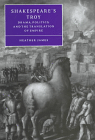
Culture 22. Cambridge: Cambridge UP, 1997.Powerfully erudite and intellectually secure, Heather James’ study, volume 22 in the Cambridge Studies in Renaissance Literature and Culture, begins on a worrisome note. James discusses Shakespeare’s use of the Troy legend as it is informed by his “overarching concern—and therefore mine . . . the legitimacy of his developing national theater” (2). But James immediately moves beyond the limits of the political interpretation, establishing the pun as Shakespeare’s—and her—primary interest. She cites Samuel Johnson’s “famous account of Shakespeare’s wordplay as the ‘fatal Cleopatra for which he lost the world, and was content to lose it’”; for Johnson, Shakespeare’s punning is a moral and cultural flaw, the sign of a dramatist “who abandons duty and authoritative language to chase after the impertinent attractions” of a quibble (3). James grounds her examination of the political and philosophical implications of the pun in the literary; thus, the subversive potential expressed by the quibble—its refusal to insist upon an authoritative rhetoric and thus upon an authoritative meaning—results in the “pleasures of doubt” (4). In this study, James pursues these Shakespearean pleasures back to Troy, and examines Shakespeare’s dramatic exemplification of England as cultural victor over Greece and Rome: “he enters England triumphantly into the translatio imperii studiique, the myth by which cultural authority migrates from Troy to imperial Rome to England and rival European states” (8). The way in which these plays differ from Shakespeare’s Roman plays is crucial to James’ argument. Rather than sharing a specific locale and political system, the plays that establish London as Troynovant share a practice of “confounding the interests of rival authorities within the Troy legend” (1). To use James’ own conceit, Shakespeare’s dramatic translation of empire quibbles with the chief authorities of empire, Vergil and Ovid. What distinguishes Shakespeare’s (de)construction of the national myth in Titus Andronicus, Troilus and Cressida, Antony and Cleopatra, Cymbeline, and The Tempest from the works of other Tudor-Stuart playwrights is the methodical way in which he “repudiates the kind of imitation that honors its model and hopes to transport some essential value from the original” (31). But Shakespeare’s emblematic imitations are ultimately iconic as well as iconoclastic: they not only juxtapose divergent classical sources to underscore their radical treatments of empire, but also emphasize the newness, mutability, and authority of the Tudor-Stuart Troynovant while mirroring the same qualities in the theater. In Chapter 2, “Blazoning injustices: mutilating Titus Andronicus, Vergil, and Rome,” James centers her argument on what she considers the turning point of Titus Andronicus—the appearance of Lavinia onstage after her rape and mutilation. It is at this moment that the play moves “from the imperial epic of Vergil to the counter-epic of Ovid” (44). The first half of Titus Andronicus is, according to James, a subversion of “Vergilian pietas”(52) and Vergilian metaphor, the former through Titus’ filicide and the latter in the “grotesque transposition of Dido’s fatal passion onto Lavinia’s mutilated and raped body” (56) via the image of the wounded doe. The pit scene of act 2 is the play’s epistemological centerpiece, beginning the violent transformation of Titus Andronicus into Ovidian parody. The pit scene begins as a version of Dido’s “counsel-keeping” cave (60) into which the characters literally and figuratively fall; after this scene of death and dismemberment, Lavinia herself emerges transformed as Ovid’s Philomela. The ravished Lavinia, with her “lopped and hewed branches,” becomes—like the emblem of the laurel tree—the literal representation of Shakespeare’s cultural translation. Because James is, in this chapter, chiefly interested in the ability of Shakespeare’s rhetoric to transmute iconography, it is the “semiotics of the pit” (64) that are responsible for meaning in Titus Andronicus: James conflates Dido’s cave (site of sexual transgression in the Aeneid), the bodies of Tamora and Lavinia, the tomb of the Andronici, and the pit; they become “semiotic black holes” (64) into which Vergilian emblems of virtue are absorbed. Titus literally returns Tamora’s sons to this pit when he slays them and serves them in a pie to Tamora, who then “swallow[s] her own increase.” Tamora, like Lavinia, must bear the brunt of the play’s classical dismemberments. And Tamora, like Titus, becomes indistinguishable from her children. This is James’ central point about the failure of Titus to transmit the classical values he had inherited and which ultimately must die with him. Not only does Titus feed Chiron and Demetrius into the pit of their mother as literary allusions (“worse than Philomel you used my daughter, / And worse than Progne I will be revenged”), but his murder of Lavinia demonstrates Titus’ conflation of himself with Ovid’s Lucrece. That is, just as Lavinia’s mute and maimed body “provided the text and authority for his vengeful identity as Procne, so her violated honor and death supply Titus with his final role, that of Lucrece” (79). James falters a bit here, I believe, by failing to provide adequate textual evidence of Titus’ Ovidian metamorphosis into Lucrece. What is clear in her analysis of the ending of the play, however, is that Titus, in the sacrifice of his daughter, tries and fails to reconstruct the Vergilian identity of pietas that has failed him. One imagines that if Saturninus had not killed Titus, Titus eventually would have gotten around to killing his twenty-fifth and sole surviving son, the “poor remainder of Andronici,” in a desperate attempt to conform to his beloved classical model. In Chapter 3, “‘Tricks we play on the dead’: making history in Troilus and Cressida,” James traces Shakespeare’s move from the Rome of Titus Andronicus to Troy, “the originary site of the translatio imperii”(85). This chapter begins by situating Shakespeare’s play in a long line of skeptical treatments of literary history and within the Tudor willingness to encourage the Troy legend qua legend while discouraging belief in its authority. The play’s Trojan setting allows Shakespeare “the means to philosophize and exacerbate [the] disillusionment” (91) associated with the fall of Essex and the late Tudor period generally. I will return to these associations shortly. In Troilus and Cressida, Shakespeare turns to quibbling with genre primarily and icons secondarily; the play’s notorious generic slipperiness is its raison d’être, and of a piece with its ideological wantonness. As James puts it, “if we search out lyric pleasures in the boudoir of Helen and Paris, we stumble into a bordello.” In James’ reading, Shakespeare searches through the competing traditions of Trojan history for the most disreputable versions of characters and events he can find. In Troilus and Cressida we meet parodies of parodies, in the sly and ridiculously eloquent Ulysses, a Cressida who turns from lover to whore in an eyeblink, and a Pandarus who must—as Mark Van Doren once described it—somehow manage to sink even lower than the characters by whom he is surrounded. All of these are exaggerations of classical heroes common to English ballad and satire, whose often contradictory and anti-classical traits had been authorized by Geoffrey of Monmouth, Fabyon, Grafton, and Holinshed. As the play veers from buffoonery to tragedy and then to other genres entirely, the characters, lacking a genre that will anchor them, veer from identity to identity. Shakespeare’s Achilles, for example, is “not the greatest warrior in Western civilization, after all, but only a set of copies” (100). Going Ovid’s skepticism toward the Greeks and his own attenuation of Roman authority in Titus Andronicus one better, Shakespeare unmoors the characters of Troilus and Cressida completely from any authority possessed by the original models, and wickedly sends these characters in pursuit of something coherent. At the center of all this repining restlessness is the “trope-plighting” (James’ quibbling pun) of Troilus and Cressida (109). The lovers’ promise to fulfill their “literary destinies” and “construct their future identities in the negative image of the other” (110), is a desperate attempt to fix themselves as stable classical models and to speak a cohesive rhetoric of translatio imperii. James ends this chapter asking what late Tudor “cultural conditions” prompted Shakespeare to so “multiply the damage caused by imitation . . . and contaminate the Troy legend” (113). Her response rests on two related events, both of them underdeveloped and insufficiently introduced. The first event, which James treats in a single paragraph, is the appearance of Chapman’s translation of Homer. In her notes, James cites several authorities for her claim that “Chapman anachronistically refeudalizes the power structures and the classical idioms that had come to proliferate in the London market,” but given the importance of this claim to her reading of Troilus and Cressida, a lengthier in-text discussion would have been appreciated. As the chapter stands, James simply ends the argument for Chapman’s significance with another pun: Troilus and Cressida “is appropriate to a city in which a chapman could have a Homer of his own” (113). According to James, Shakespeare indirectly links Essex—to whom Chapman dedicated his Homer—to Achilles, his treasonous acts to Ulysses’ behavior, and “the aftermath of the Essex rebellion” to the play itself (114-115). While James’ argument is certainly sound, especially given Andrew Gurr’s observation that Elizabeth complained the story of her relationship with Essex “had been acted forty times in the public playhouses and streets,”(Gurr 146) the very proliferation of these dramatic representations might have led James to a more comprehensive discussion of what distinguished Shakespeare’s representation. In Chapter 4, “To earn a place in the story: resisting the Aeneid in Antony and Cleopatra,” James argues that because the play is set “before the establishment of the empire under Augustus Caesar, [it] historicizes the Augustan record, revealing how the ideologically charged narrative of Antony and Cleopatra’s defeat is cast as the cornerstone of the new Roman state” (120). James makes an impressive case, in particular, for Cleopatra’s ability to appropriate the iconography of both the infinitely various goddess Isis and the magisterial Dido of the early Aeneid in the service of Shakespeare’s “interrogation of Caesar’s triumph”(121). James explores Cleopatra’s talent for manipulating these associations for political power, and argues especially for her relationship to Vergil’s Dido, whom she reads as embodying the controversial laws passed by Augustus to restrict sexual behavior and promote marriage and family. Vergil’s conflicted treatment of the legality of Dido’s relationship to Aeneas, and of the sacrifices necessary for the establishment of empire, along with the skepticism toward Augustan policy displayed by Horace and Ovid, provide Shakespeare with the raw material to assert Caesar’s superior gamesmanship and simultaneously to “record a historical yearning for a Rome that does not require the subordination of erotic desire” (123). This “historical yearning” finds embodiment in the romantic republican Antony, of course, who must, in order to challenge Caesar for the world, redefine his masculinity against the old Herculean model that will no longer serve. James believes that Antony “is unshaped only when he fully accepts the Augustan view of himself as the Roman hero emasculated by a foreign enchantress . . . [a view] canonized by Vergil’s derisive comment on Aeneas . . . as a semivir, or ‘half-man’” (129). Antony struggles to reshape himself for the balance of the play, and in various ways to “influence the ways in which readers respond to his distorted image in Vergil’s fiction” (131); chief of these attempts is his establishment of an alternate family in Alexandria—Antony, Cleopatra, and Caesarion—who, enthroned on silver and gold in the marketplace, create a portrait of domestic success. By constructing an iconographic image of kinship and opulence in opposition to Roman barrenness and austerity, Antony poses a theatrical challenge to Caesar’s authority (134). And with this display, Shakespeare likewise acknowledges and challenges the authority of the new Jacobean court. In Chapter 5, James takes up Cymbeline’s “mingle-mangle” of “sources, genre, and chronology” (151). This play is indeed an odd project, but it is also the drama concerned most directly with the translation of empire, and James demonstrates the ways in which it “threatens to dissolve rather than ratify the emergent British nation along with its Jacobean political iconography” (152). The two images that have inspired the greatest amount of critical response are Imogen’s discovery of the headless Cloten, and the “lane scene” of act 5, in which Posthumus describes the warring Britons and Romans as they have recently fought within a narrow field “ditch’d and wall’d with turf.” James takes up both of these iconographical commentaries on the translatio imperii, noting first that “Cloten is the model of [Rome’s] cultural degeneration that the play offers first as Posthumus’ foil and double” (159). However, “[a]t the crisis of the play Posthumus and Cloten become ethically indistinguishable” (160) because the political identification of each is fragmented by Britain’s initial loss in battle, by Posthumus’ problematic origins, and by Imogen’s lamenting association of the dead Cloten with the future of England. Returning to the Aeneid, James explores the relationship, via the differences offered by Aeneas and Posthumus, between the founding of Rome and the founding of Britain: in distinction to Aeneas’ effeminization by Dido and his betrayal of her for his true mistress Rome, Posthumus “earns the right to represent British masculinity only when he finds his identity through union with Imogen” (168). Imogen too branches from her mythological and Ovidian associations with both Diana and Cleopatra—the cold virgin and the voluptuous temptress, according to Iachimo—in the scene in which Imogen mistakenly caresses the headless trunk of Cloten. James associates her here not with Hecuba but with Agave, mother of Pentheus, and especially with Ovid’s bacchantes, who dismembered Orpheus (the quality of these associations is a bit strained, James’ numerous classical references notwithstanding); all of these associations, duly chased down and ruminated on quite suggestively, function “similarly to the pit in Titus Andronicus, confound[ing] distinct figures, roles, and genres . . . imperial origins and decline . . . comedy and tragedy” (172). James also addresses the play’s third striking image of political iconography, the masque of Jupiter; the god appears to Posthumus to authorize the latter as heir to Britain, but he prophesies wrongly, as Cymbeline’s long lost sons are reunited with their father at play’s end, just in time to succeed to the throne. According to James, what Posthumus loses politically he gains in characterological complexity. By radically changing the locus of imperial pursuit, from Aeneas’ love of patria to Posthumus’ embrace of the “woman’s part,” Shakespeare changes the goal of the pursuit, so that Posthumus, far from ending the play as “the orphan of heroic narrative,” grows to have a “complex relationship to his [mythohistorical and political] history and to the versions of himself” which might “broaden the sphere of politics in Cymbeline’s Britain and on the Jacobean stage” (187). James’ argument appears to struggle a bit when she discusses The Tempest, the play that demonstrates clearly how Shakespeare’s authority and influence changed the nature of Jacobean drama. In this final chapter, she recognizes that the island on which the action of the play takes place “invites specific comparison with England, the New World, and the Old World and simultaneously resists reduction to any one of them” (192). And yet, despite her repeated attempts to treat the inhabitants of this brave new world as Vergilian mutineers, James as often returns to a reading that is more Virginian than Vergilian: for example, “Prospero, like the beleaguered Sir Thomas Gates [head of the Virginia Company, whose exploits Shakespeare reworks in The Tempest] deals with a rapid sequence of rebellions, while Aeneas faces little in the way of sedition” (199). Prospero, in fact, magically attempts to force his subjects to conform to Vergilian ideals, but is forced himself—as all colonizers eventually are—to accommodate the agency, idiosyncrasy, and variety manifested by his subjects. The breakdown of Prospero’s Vergilian masque paves the way for an Ovidian tale of retribution and fury, Actaeon and his hounds, which in The Tempest becomes a pack of spirit dogs conjured up to drive away Caliban, Stephano, and Trinculo. As in Titus Andronicus, the crisis of the play hinges on this modal change, in which Ovid “interrogates Vergilian authority” (211). Unlike Titus, of course, Prospero does not enact revenge, and his challenge to Vergil’s authority ends, famously, with his own relinquishment of authority. Here James returns to the discussion that opened the chapter: what meaning should be attached to the fact that six of Shakespeare’s plays were performed at the wedding of Princess Elizabeth in 1612? “If [The Tempest] is conceived as . . . a compliment to King James . . . then the play emerges as a royal address to which other audiences are imagined as second affirmers of royal prerogative” (189). Having traced the difficulties attending utopian freedom and authoritarian rule taken up by the play, James attributes to Shakespeare the recognition that royal prerogative is not the only prerogative at stake in a national theater, and while “[e]mphatically not seditious in its themes” (221), The Tempest acknowledges the authority of the popular audience, who at any time may exercise their authority as they choose, and whose consent Shakespeare must have in order to work his “rough magic.”
Andrew Gurr, Playgoing in Shakespeare’s London (Cambridge: Cambridge UP, 1987) 146. |
|