|
| Article by: Noemi Martinez |
12/2000 |
|
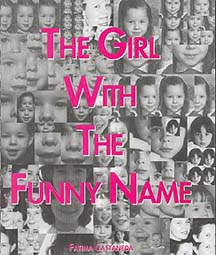
Delicately put, The Girl with the Funny Name, by Fatima
Castañeda is a self-published book. Fatima In a free-form method, we read not only poetic prose but also see artistic freedom when it comes to layout, typesetting and font. Created on her Macintosh PowerBook G3, Fatima is the DIY Grrl meets ChicLit (Chicana Literature) meets third wave Chicana. Unlike Evangelina Vigil's book of poetry, The Computer is Down, published in 1987, third wave Chicanas no longer have to "accommodate" this new technology of computers. Castañeda let her book be known by untraditional methods, at least in the Chicana/o literature community: through websites, listservs, online classifieds, forums and email conversations. Fatima Castañeda released her self-publicized, self-published book The Girl with the Funny Name, in May of 2000. She has made herself known by reading in bookstores such as Cultura Latina Bookstore, Espresso Mi Cultura and Café Con Libros. Castañeda has built a strong following and her book can be found throughout Latino/Chicano/Hispanic book sources in California. Born in Guadalajara, Jalisco, Mexico, Fatima grew up in various cities in the Los Angeles County. She was active in plays and drama throughout her education, and went to CSU, majoring in Speech Communication. Why the long bio bit on the woman and not the book? Her story is the story of many Chicanas. Publishing houses just don't "get" what Chicanas are trying to say. Those that are published, are published, and published, and published. As the introduction to her media kit says, "she waits for no one to giver her the 'go-ahead'"(xi). And her writing is good. In "Hickey," her Ama (mother) finds out she has been fooling around, yells at her, "is that a hickey…No Ama, it's nothing. Ah! She gasps and pulls the turtleneck down. Ama! I suddenly feel as if I'm in the 5th grade being caught for rolling my skirt up too high in order to get a boy to notice me for other than the tomboy princess that I am"(5). Reading The Girl with the Funny Name, I can almost list the influences that I hear in the writer's and character's voice. Many of the verses are comparable to Sandra Cisneros's, The House on Mango Street. Castañeda often uses a child's or preteen's voice that has an insight to adult emotions. This adult usually conveys an underlying knowledge that the child is not aware of yet. In the short vignette by Cisneros, "My Name," Esperanza, the child-main character, tells us her name belonged to her grandmother first:
Castañeda's "Red School Sweater"(2) starts with a young girl coming of age and trying to overcome puberty.
By the end of the poem, the girl has reached a sort of understanding,
Chrissie Castro, who reviewed it for the Arts and Entertainment section of LatinoLA.com, calls Castañeda's work "childlike in a sophisticated way." Her themes are universal. She covers sexuality, men, brothers, puberty, love and sex. Christie Castro says through Castañeda's work "the reader transverses alternate spaces: Fatima as a child. Fatima as a strong Chicana. Fatima as a lover. Fatima as an admirer. Fatima as a dreamer." And yet, her short prose is also identifiable culturally as Mexican-American, and later, Chicano. She repeatedly goes back to her roots, Mexico. But the Guadalajara that she visits is not the Guadalajara of her memories. In "Home" Guadalajara speaks to her: "'Regresa Fatima to la tierra you/ once knew.' / 'Regresa hoy a encontratre- you/ to find you" (28). When a house signs her, I feel confident that she will one again deliver. As she says in her introduction, "Let me be clear about something: I'm still a pissed-off Chicana-just now about other things. But, that's another book."
Work Sites Castañeda, Fatima. The Girl With the Funny Name. Self-published. May 2000, [email protected]. Castro, Chrissie. "The Girl With the Funny Name: A nostalgic, uplifting collection of Poetry, Thoughts and Short Stories." Arts &Entertainment. http://latinola.com/fatima.html. June 2000. Cisneros, Sandra. The House on Mango Street. New York: Vintage Books, Inc. 1989. |
|