|
|
|
| Moira Richards |
12/15/2000 |
|
This review was originally published in the Agenda
a South African feminist print journal, and is reprinted here
with permission from the author. http://www.agenda.org.za Reclaiming Our Bodies For Ourselves Women's bodies are (still) under attack! Violence against women is escalating, and women continue to be infected with sexually transmitted diseases and HIV. The media creates and reinforces ever changing images of what a woman's body should look like -- a body without which, it is suggested, she can be nothing-- and coerces us into pursuing artificial standards of physical perfection instead of encouraging us to get ourselves a life and live it. The Boston Women's Health Book Collective (BWHBC-- Inspiring a Movement of Women's Health around the World) is dedicated to addressing such problems and to enabling women to take control of their bodies and health. Their mission statement reads:
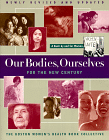
The collective started in 1969, a group of twelve women who met weekly in each others' homes to research and share information about women's health and sexuality issues. They learned to find and share medical information, and to evaluate it in terms of their feelings and experiences. They discovered the necessity of evaluating medical facts in the light of their personal experiences. This allowed them to contextualize the information and assess whether such information was accurate, fairly presented or prejudicial. They came to realize that the process of discussing, questioning and arguing with other women not only empowered them to take control of their health, but energized them to operate more effectively in all other areas too. The fruit of their labor, the first issue of Our Bodies Ourselves-- a book by women for women-- was published in 1970 and comprised a mere 120 pages. The organization has grown in thirty years from a small grassroots collective into a non-profit organization that works at an international level to encourage and empower women to take an active role in their own health as well as in the health care policies of the countries in which they live. This book, has sold over 4 million copies worldwide in a number of different languages. Now in its seventh edition as Our Bodies, Ourselves (For the new Century) it weighs in at a hefty 780 pages. The Boston Women's Health Book Collective also collaborated with Jane W Hyman and the late Esther R Rome in the production of Sacrificing Ourselves for Love (Why Women Compromise Health and Self-Esteem ... and How to Stop). In an interview with WebMD, Judy Norsigian co-author of Our Bodies, Ourselves and one of the collective's founding members , she emphasizes the 'personal is political' nature of health care (1). She argues that women need to become actively involved in articulating their health needs, to advocate policy reforms and to organize against the prejudicial treatment of women by medical insurers and inadequate legal protection of women's health. Although a comprehensive mine of health information, the books are also intended as political tools. All editions encourage women to meet, talk, listen and share experiences about their bodies, their treatment and their responses. Norsigian suggests that a self-help type of group is a very good place for women to begin their process of involvement and taking control. The authors believe that if women learn about their bodies and if they have information about their health and sexuality, then they will be equipped to ask questions and make informed decisions regarding the best surgical and medical options. Women will also be better placed to take care of themselves as well as their children and other family members for whom they are often the unpaid caregivers. They may indeed come to know more about their bodies and appropriate treatments. To this end Our Bodies, Ourselves includes a section on the politics of women's health and medical care-- what to look for in a doctor, what questions to ask about a care-plan, and the extent to which alternatives to conventional treatment can offer solutions. The experiences of hundreds of women are drawn upon to illustrate and inform the texts of both Our Bodies, Ourselves and Sacrificing Ourselves for Love. In the latest issues, the collective makes a concerted effort to include input from women of widely diverse race, class, ethnic, geographic origin and gender identity. In the last three decades, the sphere of women's health and sexuality has broadened considerably and the latest edition of Our Bodies, Ourselves offers discussion of nearly thirty different aspects of our bodies. The following examples illustrate the scope of the publication. The material on body image focuses not just on the usual complaint, "I'm too fat!!!" but includes how racism, physical disability and aging impinge upon our self-image. It contains a chapter on exercise, sport and the gender politics of professional sport and environmental and occupational health-- including the ubiquitous sexual harassment in the workplace. There is a chapter on 'Relationships with Women', including a discussion on the difficulties of living as a lesbian in a small or rural community, and the abuse and oppression that women in same sex relationships may be exposed to, from both outside and within the relationship. The section on HIV/ AIDS includes particular problems facing lesbians, women in prison, sex workers and women using artificial insemination by anonymous donor. The chapter on the politics of women's health and medical care contains an article by George J Annas on 'Our Rights as Patients' (OBOS pg 713-717). It would be interesting to compare this with the South African National Patients' Rights Charter that was launched on 3 November 1999 by the Department of Health. A chapter on the global politics of women and health gives some small insight into the problems facing women around the world-- exploitative labour practices, sex trading and high maternal mortality rates. Sacrificing Ourselves for Love is divided into three parts. The first covers health issues relating to diets and cosmetic surgery, the second and third discuss some of the consequences of domestic abuse, rape and sexually transmitted diseases (STDs). The book does not only look at the problems facing women, but also offers solutions. There are chapters overcoming eating disorders, improving our body image, what to do if raped or abused domestically and suggestions on how to insist on safer sex. Both books are of course, written against the background of the United States (US) legal system and many of the resources are US-based too. However the Women'sNet website, a South African information and gender activist network, offers such links as 'Preventing Violence Against Women' and 'Health'. The Women'sNet health pages provide information on many aspects of women's health, including for instance subscription details for GENDER-AIDS and AF-AIDS, two electronic mailing discussion forums dealing with gender and HIV/AIDS and HIV/AIDS in Africa respectively. The Boston Women's Health Book Collective has posted a dozen or so excerpts from Our Bodies, Ourselves on its website (BWHBC [b]). It links to other sites on women and health, as well as to some dealing with specific illnesses and specific health-care issues. They urge women to be critical consumers of information and to carefully consider the source, pointing out that much of the content on the World Wide Web is published with little or no editorial supervision. It may be biased by commercial interests or (as with research studies) the concerns of the drug companies, professional societies, and other advertisers who support them (BWHBC ).
Footnotes 1. WebMD interview with Judy Norsigian-- http://mywebmd.com/content/asset/chat_transcript.526953 |
|