|
|
|
| Laura Tanenbaum |
12/2000 |
|
It would seem logical that we
be drawn most strongly to fiction whose authors and characters
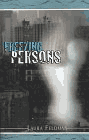
reflect our own concerns. This Telling the story of Lily, a kind of urban picaro running from her past and making a sometimes living as a dogwalker to the rich, Freezing Persons aims to chart the slippery and indirect path towards female self-discovery. Told mostly through brief scenes that shift from past to present, it gives the reader a sense of the restlessness that marks urban life for those without a roadmap. The elements of bohemian life are all there -- the tarot card reader, one night stands, the stripper -- but the overwhelming voice remains the middle-class woman "desperate for a story," as Lily herself tells us. Work is largely a marginal concern for Lily and her friends; love and sex are the battlefields where the struggle for the self takes place, and my frustration as a reader was greatest when the novel ventured onto this much-contested terrain. I had been reading a good deal of the downtown self-professed "pornographic" Kathy Acker when I read Feldman's novel, and the comparison renewed my suspicion that the difficulties of writing about sex stem not only from repression, shame and the inescapable fear of one's mother asking "so-this-is-what-you-had-in-mind-when-you-set-out-to-be-a-writer." Like Acker, Feldman seems to be asking what kind of a story our desires can tell. For Feldman, the answer seems to be catalogue of Men Behaving Quite Badly -- the scenes of joyless and at times abusive sex run together, told in a language familiar to us from the vocabulary of self-help that seems to have become so pervasive in contemporary culture. Feldman is a social worker who works with victims of domestic violence, and I don't doubt that these scenes reflect a certain truth of this experience. Unfortunately, the cultural ubiquity of texts and image representing sexual violence has made it all the more difficult to treat this material in a compelling manner that moves the reader rather than leaving her exhausted and numb. I was particularly confused by scenes in which Lily recounts acquiescing to various forms of Bad Male Behavior, such as when she describes her teenage frustration with a friend who resists a boy and thereby puts an end to her own encounter: She was having a crying fit but I didn't see the big deal, she could've just done it; she might have felt bad but she couldn't have been crying any worse than she was then choking and hysterical. Doing it would have been so much easier; it would have been nothing compared to this, what would result from this. It would have hurt less was what I thought. Just push it down, forget about it, it's only a body, it's nothing really. (153) Are we meant only to chastise younger and less enlightened versions of ourselves? How does this help us understand why we sometimes submit, or what it might mean to resist while still looking for love, companionship and sexual freedom? I don't doubt that many readers might feel differently; I suspect I might have reacted differently to the novel at a younger age. Like all opinions on the topic, what we look for in literary treatments of sex would seem to be inevitably slippery and endlessly subjective. Read more, including excerpts from the book and author biography, at the authors website: http://www.freezingpersons.com |
|