|
|
|
| By Natasha Whitton |
10/05/99 |
|
The characters in each of these novels exhibit a broad range of emotional and intellectual development. The central character of Bruno's Dream, Bruno Greensleave, is dying of cancer and seeking to discover the essence of his life. He is haunted by the betrayal of his wife, Janie, who discovered that he had a mistress when she stumbled upon them in a dressing room at Harrod's and by his separation from his son, Miles, who has not spoken to him since he made a sarcastic remark belittling Parvati, Miles' Indian fiance. Bruno broods on the waning of his time and fears: "It's all a dream . . . one goes through life in a dream" (9). Although Bruno may consider his own existence little more than a dream, he lies squarely at the center of this vast array of characters, and their activities are orchestrated around his death bed. Bruno's plea for love from Miles will cause the collision of two households, and the dust will not settle until the final chapter, in much the same way that a Shakespearean plot is set into motion in the first act and resolved in the closing scene. Bruno's fascination with spiders seems to reflect his inevitable control of the flow of the novel, and his philosophical queries represent the central theme of the work. As Frank Baldanza asserts in Iris Murdoch (1974),
Bruno continues to ponder the relationship of love and death to the last moment of his life when he wonders: "Was it only in the presence of death that one could see so clearly what love ought to be like?" (305) His epiphany is the realization that Janie had called him to her death bed to forgive him. As the dressing gown begins to move to the foot of the bed, Bruno's mind grasps the relationship of death and love, the fundamental philosophy illustrated in the novel. Danby Odell is related to Bruno only by his marriage to Bruno's daughter Gwen, but he has invited the sick, old man into his home. Danby represents the typical, bourgeois Londoner; the highlight of his life was the time that he spent with Gwen: "Danby's relationship with Gwen had seemed to him, even at the time, something that was not quite himself, but more like a visitation from outside" (141). He falters throughout the novel looking for a replacement for the love of his life while he settles for a physical romance with Adelaide, his maid. Danby appeals to the reader because he is uniquely honest. He realizes that his affair with Adelaide and his flirtation with his brother-in-law's wife, Diana, pale in comparison to his marriage. When he finds a quality in Lisa, Diana's sister, similar to what he experienced with his wife, he abandons all other women for her. Elizabeth Dipple, in her book Iris Murdoch: Work for the Spirit (1982), describes Danby as a fully fleshed out character. Not only are serious, intellectual, almost saintly women in this fiction charmed by him; he interests the reader on several levels, most significantly in the blending of his comic dimension into a larger, largely unconscious identification of him as morally valuable. (172) Dipple enlarges this idea by showing that Murdoch demonstrates through her work that the world of the comic and the world of the moral are connected. Thus, Danby's association with fun provides the source of his importance as a character in the novel. His sense of humor is tied to his understanding of death through Bruno and love with Gwen and Lisa. Danby also shows an unconscious recognition of the relationship of love and death which Bruno will more fully explain. When he declares his love to Lisa, he asks her to step into the cemetery with him, and when his proposal fails, he is left to "walk slowly away down the long avenue of tombstones" (149). Although Danby is not faced with the direct knowledge implied by this scene, he does find his replacement for Gwen. Lisa comes back to Danby, and so Danby finds someone to love him, which has been Bruno's desire from the beginning of the novel. Danby comes closest to defining Murdoch's ideal of a character who faces love and death and finds a way to live in the margin. Miles Greensleave, on the other hand, is the height of narcissism and is blinded by his desire to write. Miles enters the novel wondering why he never sees dead birds, and the reader will last see him wallowing in self pity and seeking solace in the company of his muse because Lisa has left him. His personality serves as a foil for that of Danby as he is absorbed only in his own happiness. Diana has created the ideal world for his craft by nurturing his solitude and providing him with a stable home infrastructure. Miles and Diana are both very practical about their relationship, realizing that they found each other late in life, and prefer to live in oblivious comfort. Since Parvati's death, Miles has sought only to insulate himself from the world and its pain. The poem that Miles writes for his dead love and his unborn child "only locked in his emotions rather than releasing them" (Baldanza 151). Miles chooses to focus his attention on his own problems and is not concerned about others around him unless they threaten his own security. Thus, Miles makes no attempt to see his father over the years and is upset to learn that Bruno wishes to see him. He is afraid that seeing his father will interrupt his work, even though he has been waiting unsuccessfully for the inspiring god of his poetry to come for quite some time. His attachment to Lisa and the arrival of his muse late in the drama do not serve as liberating forces but further limit Miles to his own small world of study and garden, his "dream place" (56). Diana stands out as a truly dynamic character within the framework of the novel. Murdoch obviously chose the name "Diana" with care as she represents both the hedonist and the goddess; she has done all of the work in her courtship and marriage of Miles. To her, "it was, in some extraordinary way, the perfect working our of a dream" (63). She is immersed in the simple world of the house in Kempsford Garden, in caring for her husband and her sister. Her dream world is momentarily interrupted by Danby's attentions, but this entanglement is only yet another instance of her posing. Her importance is in her relationship to Bruno. It is Diana, not Lisa, who shares the last hours of Bruno's life with him. She alone recognizes the significance of the final matches: "We'll all be paired off really, in the end. Miles has got his muse, Lisa has got Danby. And I've got Bruno. Who would have though it would work out like that?" (308) Through the consciousness of Diana, Murdoch is able to bring together the words of Nigel, the servant, with the discerning epiphany of Bruno to unite love and death. Lisa Watkin, Diana's sister, has devoted her life to pursuing philanthropic careers. She is currently teaching in a less than desirable school in East London and acts as an upsetting force in the novel. She discovers Diana and Danby alone together and disturbs their budding relationship when Danby falls in love with her. She weakens her sister's marriage by declaring her love to Miles, yet she settles for a pleasurable love alliance with Danby in the end. Dipple remarks, "She is transformed by her subsequent happiness, and nothing in the novel implies that this metamorphosis is other than positive: she laughs again, looks years younger and is filled with vitality" (173-174). She certainly loses all sense of the introspective saint that the reader might expect her to become. Lisa is a mystic like Nigel, with whom she is often compared. In fact, the similarities between Nigel and Lisa are rather startling. Both show extreme care in their treatment of Bruno and a honed sensitivity to his needs. Both express the desire to work with needy children in India, and they share a desire for Danby. Murdoch plays with the analogous qualities in these characters by allowing Danby to read Nigel's farewell letter just before Lisa taps on his window, reminding the reader of an earlier such action by Nigel. In any event, Lisa denies such spiritual edification, as Gwen has before her, for a relationship with Danby. By adding the servant triangle of Adelaide, Nigel, and Will, Murdoch sets the stage with the props of a Shakespearean domestic comedy. Dipple elaborates on this similarity beginning with Will's exchange of quotes from Shakespeare with Diana and concluding:
The comedy and tragedy of these characters provides the action and movement of the story. When any of the members of this triangle interact with the broader pentagon formed by Danby-Lisa-Miles-Diana-Bruno, the results are disastrous. Thus, Adelaide's love affair with Danby leaves her in tears, Will's professional relationship with Danby ends in a dual, and Nigel runs off to India with her unrequited love. Similarly, Diana's interaction with Will is only momentary, and Bruno's contact with Adelaide and Nigel inevitably pales in his mind. Through Nigel, Murdoch is able to express several unique philosophical views of a supreme deity. The chapters devoted to Nigel's nightly rituals make use of the typical pagan symbols of light and dark through candles and his black clothes. It is in Nigel's consciousness that the image of the angels of love and death circling the earth appears: "Love is death. All is one" (28). Baldanza points out an awkwardness in this passage:
Nigel's universal love for all things leads him to act as the omniscient watcher of the acts of humanity throughout London. He follows Danby when he seeks out Lisa in the rain and will be the cause of the dual between his brother and his employer. Oddly, Nigel will also be responsible for saving Danby's life when Will shoots at him and for saving Diana when she is on the verge of suicide. He seems to know intuitively that she wants to take her own life and relieves her of the sleeping pills while urging her to forgive and to love. When Diana questions his intimate knowledge of her circumstances, he responds:
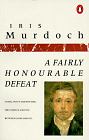
Nigel operates with a moral code which culminates in his seeking the life of sacrifice in India. Adelaide, Will, and Auntie provide comic touches that the novelist can afford. Murdoch certainly allows her tongue-in-cheek humor full-reign with these three. The convoluted love affair of Will and Adelaide echoes the confusion that exists among Danby, Diana, Miles, and Lisa. Murdoch acknowledges the simplicity of their existence by summarizing the results of their marriage, while she leaves the rest of the cast to make their own futures. From this plateau, Murdoch will expand her notion of the war between love and death to include the eternal question of good versus evil. In A Fairly Honourable Defeat, Murdoch pits the diabolic against the altruistic with love at stake. Evil will prevail, but the defeat of the good will be a fairly honourable one. The characters reflect their predecessors in Bruno's Dream. Leonard echoes Bruno's experiences near death, even though he does not know that he is dying of cancer. Baldanza describes Leonard's role in the novel as "spokesman for a withering, blindly pessimistic cynicism about the whole human show. His diatribe against the act of sexual intercourse (to say nothing of his other performances) must be one of the most corrosive in print" (164). Leonard's son, Tallis, has been deserted by his wife, Morgan, for the flashy Julius King. Morgan's sister, Hilda, welcomes her home when she leaves Julius only to have her own marriage of twenty years fall apart when her husband, Rupert, is played for a fool. Murdoch's focus within this work, however, is not the old man near death, but the young, Nigel-like Julius King who calmly manipulates those around him. He cruelly defeats Rupert and Morgan by exploiting their flaws. Using love letters that Rupert had written to Hilda and that Morgan had written to him, Julius is able to create the illusion of a love affair, because Morgan and Rupert are too vain to resist the suggestion of the other's love. Julius acts in much the same way as Shakespeare's character, Iago, in Othello. He appears to be innocent and honest to those around him, even offering his sympathy to Hilda, but he is actual at the center of the plot to destroy their peaceful existence. Murdoch, however, does not employ the connection of Julius and the audience that Shakespeare achieves through Iago's soliloquies. Instead, he remains behind the scenes, and the reader catches glimpses of his scheme only when he decides to let another character see a piece of his puzzle. The scene in which Julius provides Simon with the puppet show of the first meeting of Rupert and Morgan is a prime example, and the denouement does not come until Julius decides to confess to Tallis. Murdoch seems to enjoy creating King, and she certainly applies symbolic limits to his omnipotent glory. Julius cannot swim, and when Simon angrily pushes him into the pool he nearly drowns. He draws Morgan into a bet to separate Simon from Axel, and although he is able to destroy the marriage of Hilda and Rupert, he fails to come between the homosexual lovers. All of his tricks fall apart in the face of the truth, and Simon correctly chooses to tell Axel everything that has happened to him. So while Julius does seem to be able to pull human heart strings and to appear as if from thin air, he in certainly not all-powerful. Tallis reduces some of the mystery surrounding Julius when he discovers the tattoo from a concentration camp, showing that King had suffered. Murdoch was rather chagrined that Julius incited anger in some readers because he was Jewish. Dipple writes, "Murdoch reports with some pain that the very fact that she made Julius a Jew resulted in accusations of anti-Semitism, whereas it seems clear that she was merely identifying the Old Testament source of the Satan legend and indicating that the idea of the Prince of Darkness is the product of the Jewish imagination" (162). Whatever the author's intentions, Julius' suffering serves to limit his character. Lying under King's power is Rupert Foster. Rupert is writing a philosophical treatise as his life's work in much the same way that Miles' has struggled to create his poetical masterpiece. Rupert's flaw is his solipsistic pride which makes him readily susceptible to the notion that his sister-in-law, Morgan, is in love with him, just as Miles' was flattered to learn of Lisa's devotion. Rupert has lived in his own shock-proof world of marriage for the last twenty years and believes that "there's a sort of ordered completeness of life and an intelligent use of one's talents which is the mark of a man" (22). He stands at the height of his career ready to pass judgement when his own house is in sad disorder. His son will be responsible for the destruction of his life's work, and his wife's lack of faith in his character will lead to his death. On the other hand, Tallis Browne's problem seems to be a complete lack of ego. Tallis takes no pride in his surroundings or in his work; he awaits the return of his wife. Yet, Tallis symbolizes the surviving good in the final pages of the novel, and his strength of character leads Julius to confess to him. Tallis is Danby's counterpart, but he does not get the girl in the end. Dipple suggests that his name is associated with the sixteenth-century British composer, Thomas Tallis, which would follow the harmonic quality that Browne exercises on the cast. It is Tallis who offers to take in Peter after he drops out of Cambridge, and it is Tallis who, like Danby, cares for his sick father. In his showdown with Rupert, King points out:
Thus, Tallis is perfectly dull because he possesses Murdoch's quality of goodness, while Julius fascinates. Yet, while Tallis may appear to be vague and spineless, he shows courage in several ways. He runs into Julius having dinner with Axel and Simon, and while his gesture of extending his hand may be seen as stupidity, he does not flee the confrontation with his wife's lover. When Simon becomes involved in a gang fight when the four are to meet at a Chinese restaurant, it is Tallis who wins the physical victory. Finally, as soon as Julius confesses, Tallis leads him to the phone to set things right. This strength, however, is not recognized by Morgan who flees the figure of her impotent husband. Morgan acts as a whirlwind force throughout the novel, throwing about her childish narcissism, as Morgan Le Fay threw her weight around in the Arthurian court. Her lack of consideration and responsibility is appalling. She is quite willing to gamble with Julius over the dissolution of a love relationship, and she seems equally eager to destroy her sister's marriage. Morgan's impressionable mind takes on the characteristics of Julius. No where is this better illustrated than in the museum scene in which he criticizes Turner, and Morgan actually begins to see the paintings differently. She seems incapable of independent thought and is hopelessly unable to make a decision about her husband. When she is with him, she is drawn to the boy that she saw in him when they married, just as she is converted to King's manner of thinking when she is with him. Morgan is easy prey to Julius' machinations. Hilda, like Diana, has chosen to devote her life to domesticity and has existed vicariously through her husband and son. She is as prepared for Rupert's betrayal as she is capable of dealing with Peter. She has pampered her son by giving him extra spending money, and Julius uses this deception to cloud her vision of her own marital bliss. While Diana seems to be able to overcome her disillusionment, Hilda does not rise from the ashes of her husband's death. In fact, Murdoch leaves her in California living with Morgan and taking care of Peter, while sending letters to Tallis. Hilda's response to her husband's death appears to be denial instead of the eventual knowledge that Murdoch demonstrates in Diana's consciousness in Bruno's Dream. The domestic and comic relationship to be found in A Fairly Honourable Defeat is that of Axel and Simon. This odd couple survives the torments of Julius King and is actually made stronger by his antics. Axel provides a stable voice that will be heard over those of Peter and Julius. Although he is embarrassed about his relationship with Simon and does not share it with his business associates, he is quick to admit his fault. He may occasionally preach to others, but he is willing to accept correction. Simon's weaker personality had at one time drifted from person to person, like Morgan, but in Axel he recognizes a soul mate with whom he is unwilling to part. Their intimacy is built on honesty, and it is this quality that will save them from Julius. These two novels show Iris Murdoch's ability to tackle philosophical issues with fresh wit and fervor. The detail and craftsmanship which she shows in her work demonstrate her talent as an artist. Baldanza comments, "Miss Murdoch's command of wines, food, fabrics, London demography, and astonishing arcane intellectual specialties continues unabated" (164). Whether her characters are going to the opera or reading a book, the overall effect will be dazzling. Here, she successfully defines good and evil and shows the repercussions of death and corruption on love. Baldanza, Frank. Iris Murdoch.
Twayne Publishers, Inc. New York, 1974. |
|
|
|
|
|